Παρασκευή 29 Μαρτίου 2013


Easter words


Language tip of the week: Easter words
In this weekly post, we bring more useful content from the Macmillan Dictionary to English language learners. These tips are usually based on areas of English which learners find difficult, e.g. spelling, grammar, collocation, synonyms, etc.
This week, we look at some Easter vocabulary.Easter is a movable feast. The term itself describes a Sunday in March or April when Christians celebrate the time when Jesus Christ died then returned to life according to the Bible. It also refers to the holiday period that includes Easter day. Here are some more useful terms to know:
Easter egg (noun)Check out the Macmillan Dictionary & Thesaurus for more terms relating to important days in the Christian calendar.
1 a chocolate egg that you give to someone as a present at Easter
2 an egg that children decorate in celebration of Easter
Cultural note: Children often go on Easter egg hunts to find eggs that have been hidden around their home by the Easter bunny.
Easter Sunday (noun)
the Sunday in March or April that Easter is celebrated on
Lent (noun)
the period of 40 days before Easter, starting on Ash Wednesday, when some Christians stop eating or doing something that they enjoy
Holy Week (noun)
in the Christian religion, the week before Easter Sunday
Palm Sunday (noun)
the Sunday before Easter, when Christians remember Christ’s journey to Jerusalem before he died
Maundy Thursday (noun)
the Thursday before Easter when Christians celebrate the last supper of Jesus Christ
Good Friday (noun)
the Friday before Easter, which Christians remember as the day that Jesus Christ died
Passion play (noun)
a play about the death of Jesus Christ according to the Bible, often performed at Easter
hot cross bun (noun)
a sweet cake for one person, marked with a small cross on the top and traditionally eaten at Easter
simnel cake (noun) (British)
a type of cake containing dried fruit, traditionally eaten at Easter
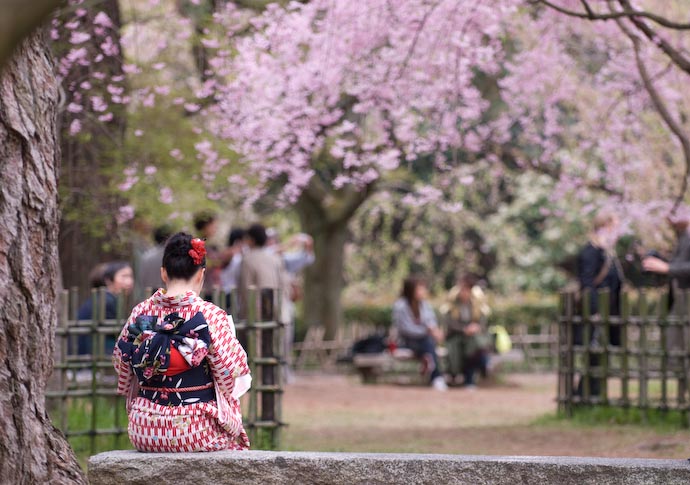
SPRING IN JAPAN

Cherry Blossoms
Cherry Blossoms (SAKURA) in Japan
 Cherry blossoms (SAKURA) are Japan’s unofficial national flower,
formerly called tree flower (KONOHA). In Japan’s early history it ranked
second after plum blossoms (UME). Cherry blossoms overtook plum
blossoms approximately after the eighth century. In Chinese, the single
character for flower is used to represent plum blossoms, while in
Japanese, character for flower signifies cherry blossoms.
Cherry trees are planted in many places, and wherever you go, flowers are in bloom only for a short period of time. Most unfortunately, they bloom in spring when the weather is unpredictable, and sudden merciless rains often scatter away the petals of pale pink.
Due to Japan’s long geographical north-south extension, cherry blossoms bloom during different times of spring throughout the country, starting from Okinawa moves gradually northward and ends its journey in Hokkaido. The weather bureau issues forecasts of where the "cherry-blossom front (SAKURA ZENSEN)" is moving.
 Cherry
blossom viewing began in ancient times. Since the Heian Period (794 to
1185) flower viewing was popular among the aristocrats who recited
poetry under the trees in full bloom.
In the Azuchi Momoyama Period (1568-1600) and the Edo period (1603-1868) cherry blossom viewing spread out to the general public.
Japanese public like cherry blossoms because shapes and colors of their petals represent people’s ideal notions of purity and simplicity. Fragile and ephemeral flowers are scattered away in gust of winds just a few days after in the full bloom. There are so many sites around the country that are famous for their spectacular blossoms that one cannot visit to admire all cherry blossoms sites in his/her lifetime.
There are dozens of different varieties of cherry blossoms in Japan, most of which bloom for just a couple of days in spring. Many of the cherry trees in famous viewing spot are cultivated, but wild cherry blossoms are also admired.
Cherry Blossom Viewing (Sakura-no-toorinuke) in Japan Mint
 Every
year, during cherry blossom time around the middle of April, the
premises of Japan Mint along the entire "Yodo" riverside lane, a full
length of 560m, is opened to the public for one week for cherry blossom
viewing.
Around two weeks prior to the Cherry Blossom Viewing (Sakura-no-toorinuke) in Japan Mint, we are impressed to see the "Okawa" river charmingly change – lined with thousands of cherry trees as far as we can see in either direction.
Cherry blossoms really are breathtaking. We are particularly struck by the subtle variations in color.
Cherry blossoms are mainly from Kyoto, Tokyo and Hokkaido. Only one variety, "TAIHAKU" came back from foreign soil, thanks to the real gentleman of the UK.

 |
| photos from JEFFREY FRIEDL'S BLOG |

Festival of Colors - World's BIGGEST color party
Festival of Colors - World's BIGGEST color party - YouTube
India's Spring Festival Is Like None Other!
 Indians love festivals! Not a month goes by without a celebration. But none are as fun as Holi, the festival of color. Held annually at the beginning of spring on the day after a full moon, this year's festival happens to be today - March 27th, 2013.
As with all Hindu festivals, this one also has a number of different folk tales associated with it - The majority center around the triumph of good over evil. The most popular one is about an arrogant king who resents his son Prahlada for worshipping the creator of the Universe - Lord Vishnu. When every attempt to stop him fails, his sister Holika, believed to be immune to heat, joins in the effort by inviting the young boy to accompany her into a large fire. Helped by the powers of Lord Vishnu, Prahlada escapes unscathed, while Holika burns to ashes. To commemorate this event, huge bonfires are lit the night before Holi, to cleanse the air of evil spirits.
 In the North Indian State of Uttar Pradesh, the fun festival is attributed to the immortal love between the mischievous fun-loving god Krishna and his wife Radha. They are still so revered that the residents of Mathura, (where he was born) and Vrindavan, (where he spent most of his life), celebrate it with great abandon, for almost two weeks!
What's so great about this day? While there are some fun processions, folk song and dance performances, the best part about the festival is the ritual of taking to the streets early in the morning and splashing friends and even total strangers with dry colors, water balloons, water guns and even, dousing them with entire buckets of colored water - On this day everyone, young and old, is fair game.

At about midday, the friendly mayhem comes to an end and people living close to oceans or rivers, usually take a dip in the water to cleanse off, before trudging home to a delectable homemade feast and a well-deserved siesta.
from: http://www.dogonews.com/2013/3/27/indias-spring-festival-is-like-none-other
movie time:Sense and Sensibility
MOVIE TIME:The Notebook
from:
http://englishwordoftheday2010.blogspot.gr/2013/02/the-notebook.html


IDIOM OF THE DAY - {AS}
IDIOM OF THE DAY - {AS}
1 'As against'
[In contrast to, in comparison with]
Income was £l million this year, as against only £800,000 last year.
2 'As ... as they make ’em'
[Used to express an extreme degree of quality of someone or something, usually of bad characteristics]
Your new girlfriend’s as cheeky as they make ’em, isn’t she?
In this phrase ’em is almost always used instead of them.
*Also 'As ... as they come'
That chap’s as stupid as they come.
3 'As for'
[Concerning] used to elaborate further on an earlier statement
We’ll be able to have new science laboratories, but as for the project to rebuild the swimming pool, that’ll have to wait; there simply isn’t the money, I’m afraid.
4 'As if ...'
[An expression of annoyance, to show disapproval of a suggestion, statement, explanation, etc.]
As if you expect me to believe that story! / As if I cared whether you were here or not!
*Also used by itself, to show disbelief
I’m going to take you out for a meal on Saturday! -As if! You’ve said that so many times before, and never done it.
5 'As it is'
[In reality; in the existing state of affairs]
As it is, I shall probably only just finish all my work
today, without taking on any more. / The weather’s awful today, as it is, so I’ve no hope of getting the washing
dry.
*Also 'As it turns out' ; 'As things stand'.
6 'As it were'
[If it might be expressed in this way; as if it were really like this] used with a strange way of saying something or to make a statement seem less definite
Language is, as it were, a mirror of what a society is like. / Our house in the country is our second home, as it were.
7 'As you were'
[An expression used to withdraw what has just been said]
The number is 720 ... No, it’s not! As you were! It’s 7202!
*Originally, a military order to return to the previous position.
8 'It’s not as if'
[Used to state that something is most certainly not true]
You’re not going to miss her much when she’s gone, are you? It’s
not as if you were close friends.
taken from the GLOBAL ELT ENGLISH IDIOMS DICTIONARY
WORD OF THE AY :QUIET
Thesaurus-Synonyms- QUIET
'quiet' adjective not producing or characterized by much noise, or not loud: Be quiet when I’m talking to you! * αθόρυβος: ήσυχος, στον οποίο απουσιάζει θόρυβος ή κίνηση: σιωπηλός
[faint] very quiet, quite difficult to hear: a faint rustling noise.
* αδύναμος, αμυδρός, άτονος, αδιόρατος, ανεπαίσθητος
[hushed] quieter than usual, especially deliberately made quieter than usual: People waited in the church, talking in hushed voices.
* που σιωπά, που κατασιγάζει, κν. «καλμαρισμένος»
[inaudible] unable to be heard: There was so much noise in the hall that parts of the speech were almost inaudible. * σιγαλός, μη ακουόμενος
[muffled] not heard as clearly or not sounding as loud and sharp as usual, because there is something between you and the source of the sound: a muffled explosion. * που καταπνίγει τον ήχο, κατασιγασμένος,: «φιμωμένος»
[silent] producing or characterized by no sound at all, or not speaking: Everyone in the room fell silent. * σιωπηλός, άφωνος, «βουβός»
[soft] not loud and usually having a gentle quality: a soft voice.
* (για φώς, χρώματα ή ήχους:) «απαλός»
taken from the BETSIS ELT DICTIONARY & THESAURUS


Top 10 Unsolved Mysteries of The World
Man has made major advancements today. Whether it is the field of technology, science, medicine, arts or commerce, he has got almost everything in the world under his control. Despite so many researches by scientists and experts, there have been certain unexplained phenomena which we call as unexplained mysteries. Let us have a look at the top 10 unsolved mysteries of the world.
Top 10 Unsolved Mysteries of The World | SimplyTop10.com

Top 10 Unsolved Mysteries of The World | SimplyTop10.com
April Fool’s Day
On this episode of The Spangler Effect, Steve shares a few of his favorite science pranks to pull on April Fools Day! With a magnet, baby diaper, spray can and a Starbucks cup, you too can have your own fun on April 1st!


Πέμπτη 28 Μαρτίου 2013
EMOTIONS
FEELINGS & EMOTIONS, by Carmen Coronel
Find this and other feelings exercises in English Exercises .org

Find this and other feelings exercises in English Exercises .org

THE MEATRIX® I AN ANIMATED DOCUMENTARY ABOUT MASS MEAT PRODUCTION
Join Leo, the young pig who wonders if he is "the one", Chickity, the feathered family farm defender, and Moopheus, the trench-coat-clad cow with a passion for green pastures as they expose the problems with factory farming while making the world safe for sustainable family farms.
Continents of the world
Toy Stories from all over the world
Toy Stories | gabriele galimberti
 Everyone remembers their childhood toys. Indeed, when Galimberti hit upon the idea of photographing children from around the world with their toys, he was not expecting to uncover much we did not already know: kids love dolls and dinosaurs and trucks and cuddly monkeys, and will construct worlds around them before eventually, inevitably, disregarding them for ever. “At their age, they are pretty all much the same,” is his conclusion after 18 months working on the project. “They just want to play.”But how they play can reveal a lot. “The richest children were more possessive. At the beginning, they wouldn’t want me to touch their toys, and I would need more time before they would let me play with them,”
More common was how the toys reflected the world each child was born into: so the girl from an affluent Mumbai family loves Monopoly, because she likes the idea of building houses and hotels, while the boy from rural Mexico loves trucks, because he sees them rumbling through his village to the nearby sugar plantation every day.
Ultimately, the toys on display reveal the hopes and ambitions of the people who bought them in the first place. “Doing this, I learnt more about the parents than I did about the kids,” says Galimberti.
Everyone remembers their childhood toys. Indeed, when Galimberti hit upon the idea of photographing children from around the world with their toys, he was not expecting to uncover much we did not already know: kids love dolls and dinosaurs and trucks and cuddly monkeys, and will construct worlds around them before eventually, inevitably, disregarding them for ever. “At their age, they are pretty all much the same,” is his conclusion after 18 months working on the project. “They just want to play.”But how they play can reveal a lot. “The richest children were more possessive. At the beginning, they wouldn’t want me to touch their toys, and I would need more time before they would let me play with them,” More common was how the toys reflected the world each child was born into: so the girl from an affluent Mumbai family loves Monopoly, because she likes the idea of building houses and hotels, while the boy from rural Mexico loves trucks, because he sees them rumbling through his village to the nearby sugar plantation every day.
Ultimately, the toys on display reveal the hopes and ambitions of the people who bought them in the first place. “Doing this, I learnt more about the parents than I did about the kids,” says Galimberti.
IDIOMS

The following is a list of some of the most widely-used idioms in everyday English and their meanings.
IDIOMS:
1. "A penny for your thoughts"
2. "Add insult to injury"
3. "A hot potato"
4. "Once in a blue moon"
5. "Caught between two stools"
6. "See eye to eye"
7. "Hear it on the grapevine"
8. "Miss the boat"
9. "Kill two birds with one stone"
10. "On the ball"
11. "Cut corners"
12. "To hear something straight from the horse's mouth"
13. "Costs an arm and a leg"
14. "The last straw"
15. "Take what someone says with a pinch of salt"
16. "Sit on the fence"
17. "The best of both worlds"
18. "Put wool over other people's eyes"
19. "Feeling a bit under the weather"
20. "Speak of the devil!"
MEANINGS:
1. This idiom is used as a way of asking someone what they are thinking about.
2. When people add insult to injury, they make a bad situation even worse.
3. This idiom is used to speak of an issue (especially in current affairs) which many people are talking about.
4. This is used when something happens very rarely.
5. When someone finds it difficult to choose between two alternatives.
6. This idiom is used to say that two (or more people) agree on something.
7. This means ‘to hear a rumour' about something or someone.
8. This idiom is used to say that someone missed his or her chance at something.
9. This means ‘to do two things at the same time'.
10. When someone understands the situation well.
11.When something is done badly to save money. For example, when someone buys products that are cheap but not of good quality.
12.To hear something from the authoritative source.
13. When something is very expensive.
14. The final problem in a series of problems.
15. This means not to take what someone says too seriously. There is a big possibility that what he/she says is only partly true.
16. This is used when someone does not want to choose or make a decision.
17. All the advantages.
18. This means to deceive someone into thinking well of them.
19. Feeling slightly ill.
20. This expression is used when the person you have just been talking about arrives.
FROM:English second language chat page

Εγγραφή σε:
Αναρτήσεις (Atom)